
Table of Contents
ToggleEsports coverage vs traditional sports coverage, it’s a debate that’s reshaping how millions consume competitive entertainment. The rise of professional gaming has created an entirely new media landscape, one that operates by different rules than the NFL broadcast your parents grew up watching. While traditional sports networks still command massive audiences, esports platforms are rewriting the playbook on viewer engagement, accessibility, and real-time interaction. This article breaks down the key differences between these two worlds, from broadcasting formats to audience behavior, and explores what the future holds for sports media as a whole.
Key Takeaways
- Esports coverage is digital-first, offering free access on platforms like Twitch, while traditional sports coverage often requires expensive cable packages or subscriptions.
- Esports broadcasts feature real-time chat integration and interactive elements that traditional sports coverage is only beginning to adopt.
- Esports audiences skew younger (18–34) and engage daily through mobile devices, whereas traditional sports viewers trend older and favor television.
- Traditional sports coverage benefits from decades of institutional knowledge and established production standards, but struggles to capture younger attention spans.
- Both industries are learning from each other—traditional sports are adding interactive features while esports is professionalizing its production quality.
- The future of sports media will blend both approaches, with streaming, interactivity, and global accessibility becoming standard expectations for all viewers.
What Is Esports Coverage?
Esports coverage refers to the broadcasting, reporting, and media production surrounding competitive video gaming. It includes live tournament streams, post-match analysis, player interviews, and dedicated news platforms covering games like League of Legends, Counter-Strike, Valorant, and Dota 2.
Unlike traditional sports, esports coverage was born on the internet. Platforms like Twitch, YouTube Gaming, and Facebook Gaming serve as primary distribution channels. This digital-first approach means esports coverage reaches global audiences without relying on cable subscriptions or regional broadcast rights.
The format differs significantly from what viewers might expect from ESPN or Fox Sports. Esports broadcasts often feature:
- In-game camera perspectives controlled by observers
- Real-time statistics and player performance overlays
- Chat integration allowing viewers to interact during matches
- Multiple language streams running simultaneously
Major esports events like The International or the League of Legends World Championship draw viewership numbers that rival, and sometimes exceed, traditional sporting events. The 2023 League of Legends Worlds Finals attracted over 6 million peak concurrent viewers, demonstrating the scale esports coverage has achieved.
Esports coverage also includes a thriving ecosystem of independent content creators, analysts, and journalists who produce daily content outside official tournament broadcasts. This grassroots media layer adds depth that traditional sports coverage often lacks.
How Traditional Sports Coverage Compares
Traditional sports coverage has evolved over more than a century. Television networks, radio stations, and print media established the frameworks that still govern how games reach audiences today. Networks like ESPN, NBC Sports, and Sky Sports control major broadcast rights and set production standards.
The structure follows a predictable pattern: pre-game shows, live event coverage, halftime analysis, and post-game breakdowns. Camera angles, instant replays, and expert commentary have become industry standards that viewers expect.
Traditional sports coverage operates within strict broadcast windows. A football game airs at a scheduled time, and viewers tune in or miss it. While DVR and streaming services have added flexibility, the core model remains appointment-based viewing.
Key characteristics of traditional sports coverage include:
- High production budgets with professional camera crews
- Established commentator personalities with decades of experience
- Exclusive broadcast rights worth billions of dollars
- Regional blackouts and geographic restrictions
- Heavy reliance on advertising revenue during commercial breaks
Traditional coverage also benefits from deep institutional knowledge. Sports journalists have covered their beats for years, building relationships with players, coaches, and front offices. This access produces insider reporting that newer esports outlets are still developing.
But, traditional sports coverage faces challenges. Younger audiences increasingly consume content through social media clips rather than full broadcasts. The three-hour game format struggles to hold attention spans shaped by short-form video.
Major Differences in Broadcasting and Media
The broadcasting differences between esports coverage vs traditional sports coverage extend beyond platform choice. They reflect fundamentally different philosophies about how audiences should experience competition.
Production and Camera Work
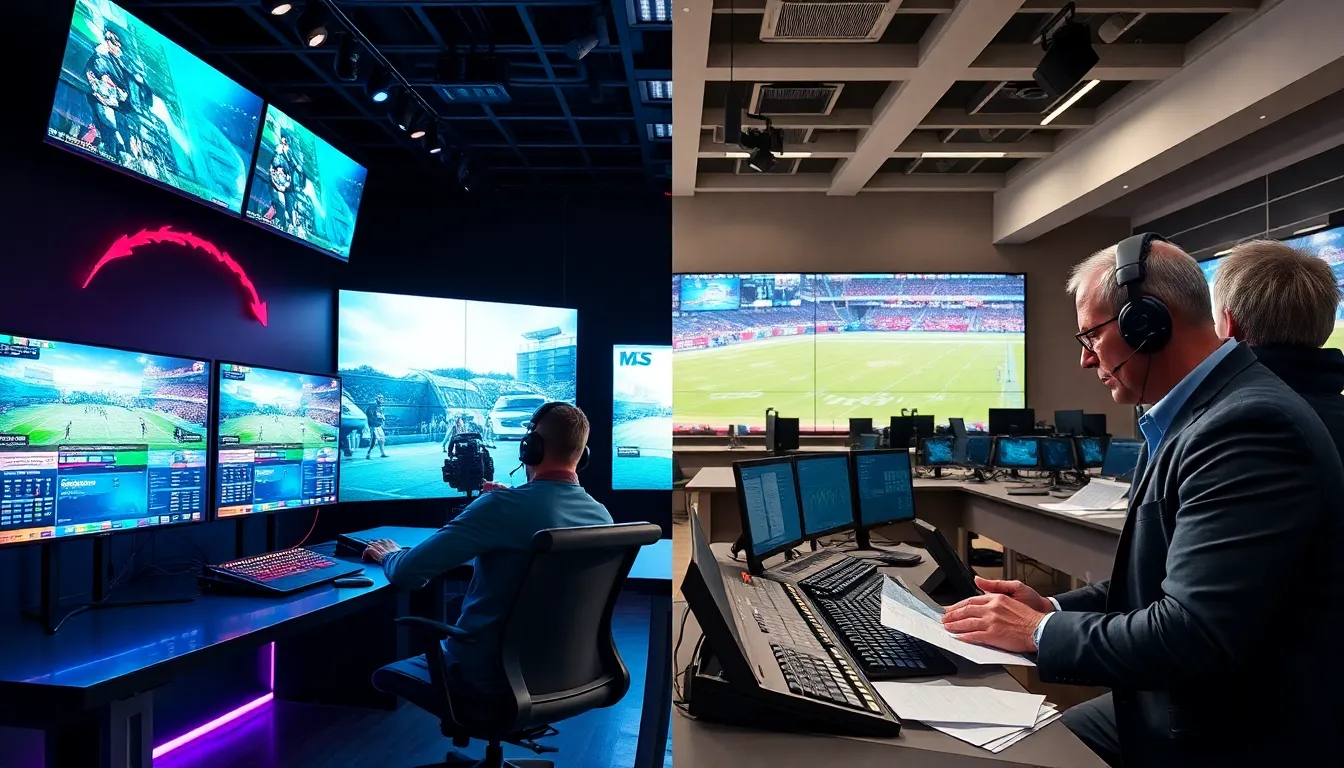
Traditional sports use physical cameras positioned around stadiums and arenas. Esports broadcasts rely on virtual observers who control in-game cameras, switching between player perspectives and overhead views. This gives esports producers flexibility that physical cameras can’t match, they can show any angle, at any time, without equipment limitations.
Accessibility and Cost
Most major esports tournaments stream free on platforms like Twitch. Traditional sports increasingly sit behind paywalls, with cable packages and streaming subscriptions costing hundreds of dollars annually. This accessibility gap shapes who watches what.
Commentary Style
Esports casters tend to be younger and more casual in their delivery. They explain game mechanics for newcomers while maintaining hype for experienced viewers. Traditional sports commentary assumes baseline knowledge and focuses on strategy and historical context.
Interactive Elements
Esports coverage integrates live chat, predictions, and viewer rewards directly into broadcasts. Traditional sports have experimented with second-screen experiences but haven’t achieved the same level of real-time interaction. Twitch chat during a major esports final creates a shared viewing experience that traditional broadcasts struggle to replicate.
Global vs Regional
Esports coverage launches globally from day one. A tournament in South Korea streams simultaneously to viewers in Brazil, Germany, and the United States. Traditional sports coverage operates regionally, with complex rights deals limiting access by geography.
Audience Engagement and Viewing Habits
Audience behavior reveals some of the starkest contrasts between esports coverage vs traditional sports coverage. Demographics, viewing patterns, and engagement styles differ substantially.
Esports audiences skew younger. The average esports viewer is between 18 and 34 years old. Traditional sports audiences trend older, with the average NFL viewer now in their 50s. This age gap influences everything from advertising strategies to platform choices.
Viewing habits also diverge:
- Esports fans frequently watch on mobile devices and computers
- Traditional sports viewers still favor large-screen televisions
- Esports audiences engage in multi-tasking, chatting, browsing social media, and watching simultaneously
- Traditional sports viewers tend toward more passive consumption
The parasocial relationships differ too. Esports fans often follow individual streamers and content creators who compete professionally. They’ve watched these players for years on personal streams, creating connection that traditional sports athletes rarely achieve outside of social media.
Traditional sports benefit from generational loyalty. Families pass down team allegiances. Esports fandom tends toward specific games and players rather than organizations, though established teams like T1 and Cloud9 are building lasting brands.
Engagement extends beyond match viewing. Esports fans consume analysis videos, highlight clips, and player content daily. Traditional sports fans follow similar patterns but typically engage less frequently outside game days.
The Future of Sports Media Coverage
The gap between esports coverage vs traditional sports coverage will narrow over the coming years. Both industries are learning from each other, and hybrid approaches are emerging.
Traditional sports networks have started adopting esports techniques. The NFL’s partnership with Nickelodeon produced broadcasts featuring on-screen graphics and interactive elements borrowed directly from gaming culture. NBA League Pass now offers alternative broadcasts with enhanced statistics and different commentary options.
Meanwhile, esports is professionalizing. Production quality continues to rise. Riot Games and Valve invest millions in broadcast infrastructure. Former traditional sports executives now lead esports media companies, bringing institutional knowledge to a young industry.
Several trends will shape the future:
- Streaming will become the default distribution method for all sports
- Interactive viewing features will become standard across platforms
- Shorter highlight formats will supplement long-form broadcasts
- Regional restrictions will face pressure from global audiences
- Younger demographics will demand the engagement styles esports pioneered
Advertisers are adjusting too. Brands that once dismissed esports now compete for sponsorship slots. Energy drinks, computer hardware, and automotive companies have recognized where younger consumers spend attention.
The question isn’t whether esports coverage will replace traditional sports coverage. Both will coexist, each adapting to serve different audiences and preferences. The real shift is in expectations, viewers now want interaction, accessibility, and community regardless of what they’re watching.